1970 Jennings (VOX) Rifle Guitar - The Winchester
When a Repair Isn’t Simple
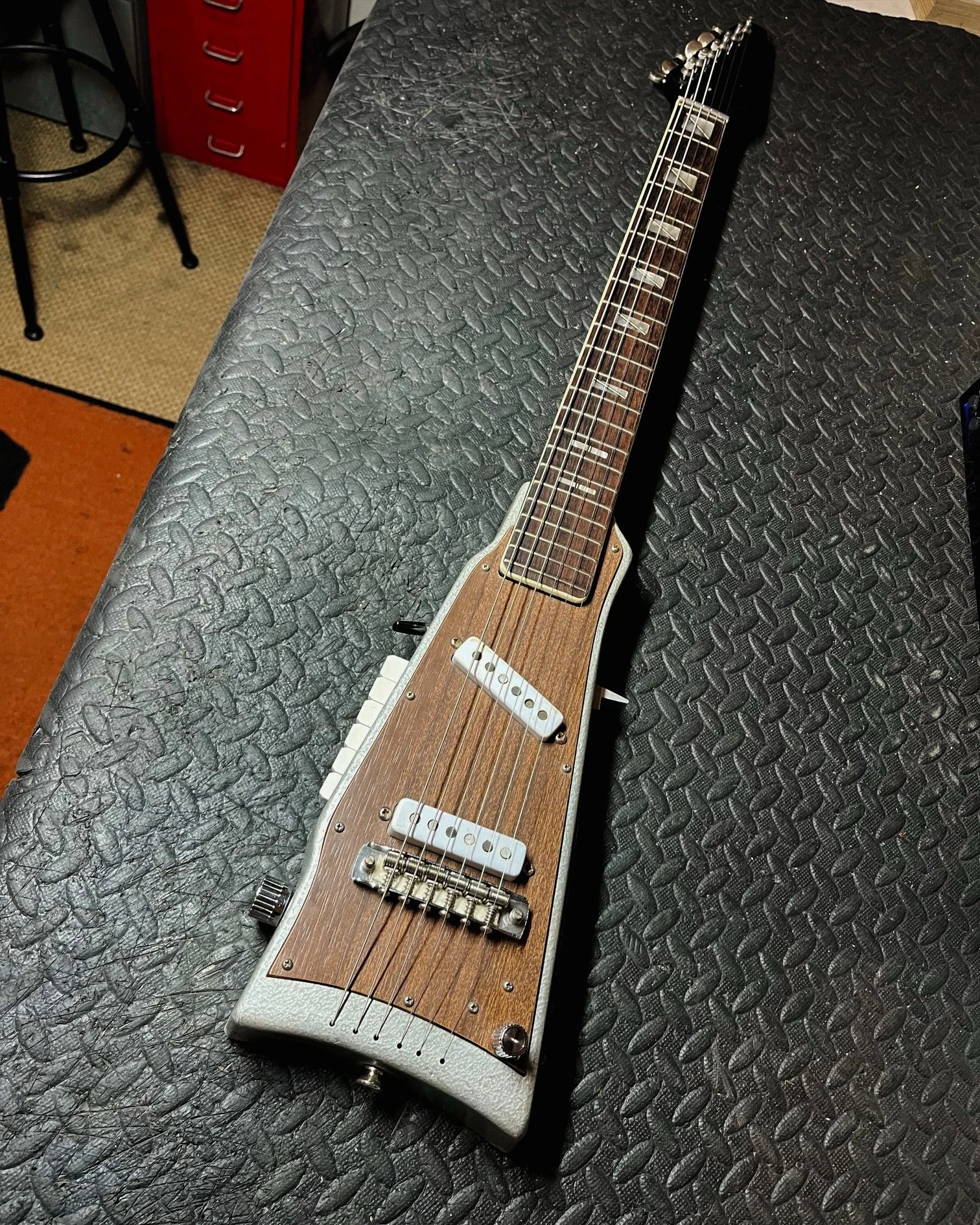
The Jennings Rifle Guitar – “The Winchester”
Every now and then, something turns up on the bench that immediately tells you it’s not going to behave like anything else. I‘ve certainly seen a lot over the decades of repairing guitars & musical instruments, but there’s always something new to find. Here’s something that is so rare, I didn't even know it existed until someone came into the shop with it, all the way from Switzerland!
It’s a Jennings ‘Rifle’ Guitar, specifically, the ‘Winchester’ model. I mean, how many of these can be out there, maybe a dozen? I honestly don’t know, and that also is what lent itself to the challenge of repairing it. In nearly 30 years of working on guitars and musical equipment, this is the first one I’ve come across. That alone tells you something; there can’t be many of these out there. It’s not just unusual in design, it’s rare in the most literal sense, and once you get inside it, you quickly understand why.
This particular example, I believe, is from 1970, because this is when the current owner’s father purchased it, and it’s been in the family ever since.
A Product of a Different Moment
The Winchester comes from the later period of Tom Jennings’ work, after his departure from Vox and the earlier success of Jennings Musical Industries. When Jennings Musical Industries collapsed in late 1967, largely as a result of its parent company, Royston Industries failing, Tom Jennings suddenly found himself without the company he’d built from the ground up. He had already stepped away earlier that year, unhappy with the direction things were heading, but the full collapse of JMI effectively closed that chapter for good. Right at that moment, Vox was already moving in a much more experimental direction.
What’s interesting is that, at the time of JMI’s collapse, Jennings and his team, including Dick Denney, were already in the process of developing a new and rather unconventional instrument. One of the ideas being developed in 1967 was the original Winchester concept; a small-bodied, unconventional guitar design that hinted at integrating effects and more compact forms into the instrument itself. This was a compact, experimental guitar design, reportedly based around a reworked wah-wah pedal enclosure, and represented a clear move toward more integrated, effects-driven instruments.
Rather than abandoning that direction, Jennings carried it forward. By 1968, he had set up Jennings Electronic Industries and began developing a new range of instruments under his own name, picking up where those late Vox-era ideas had left off.
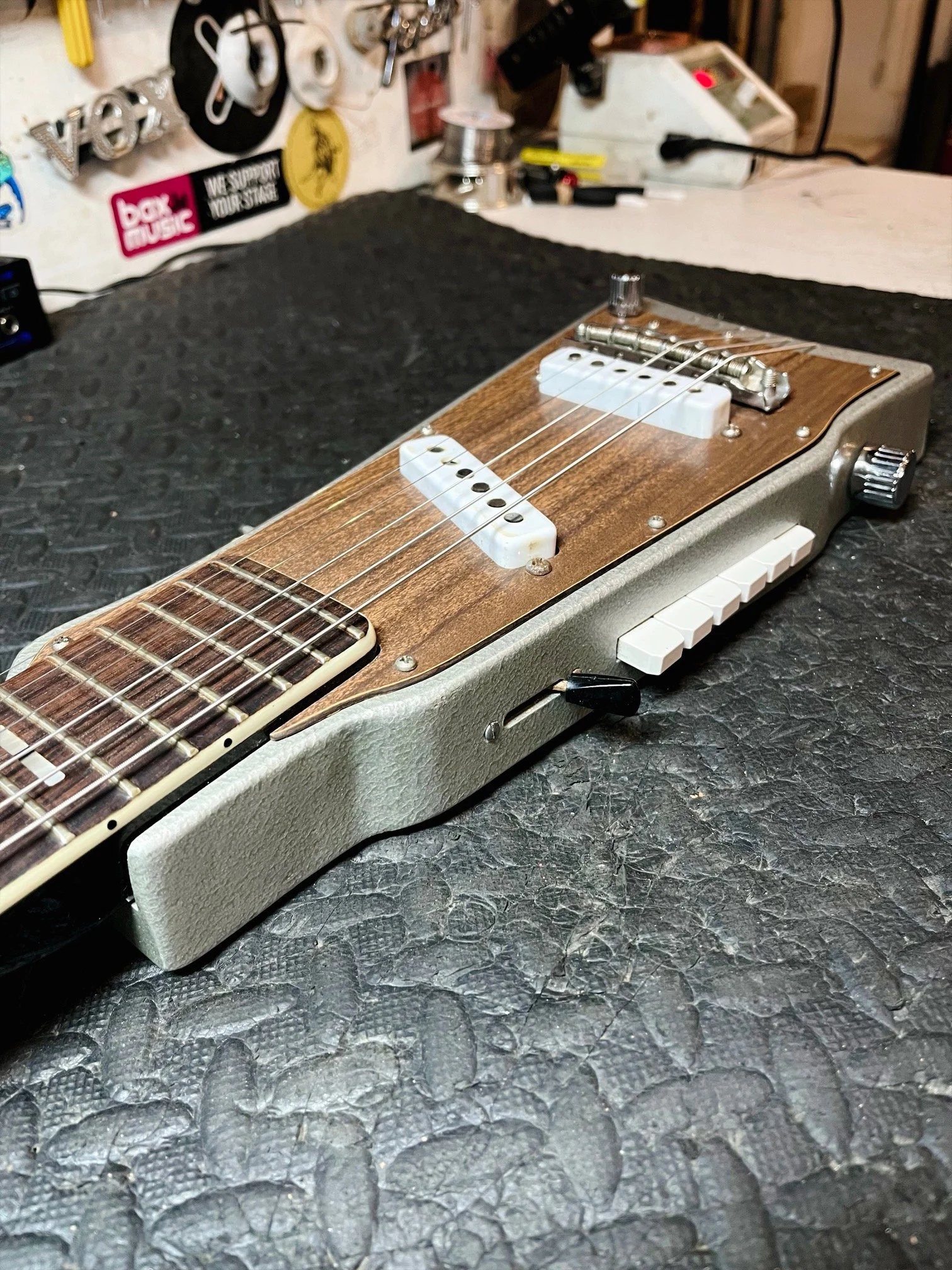
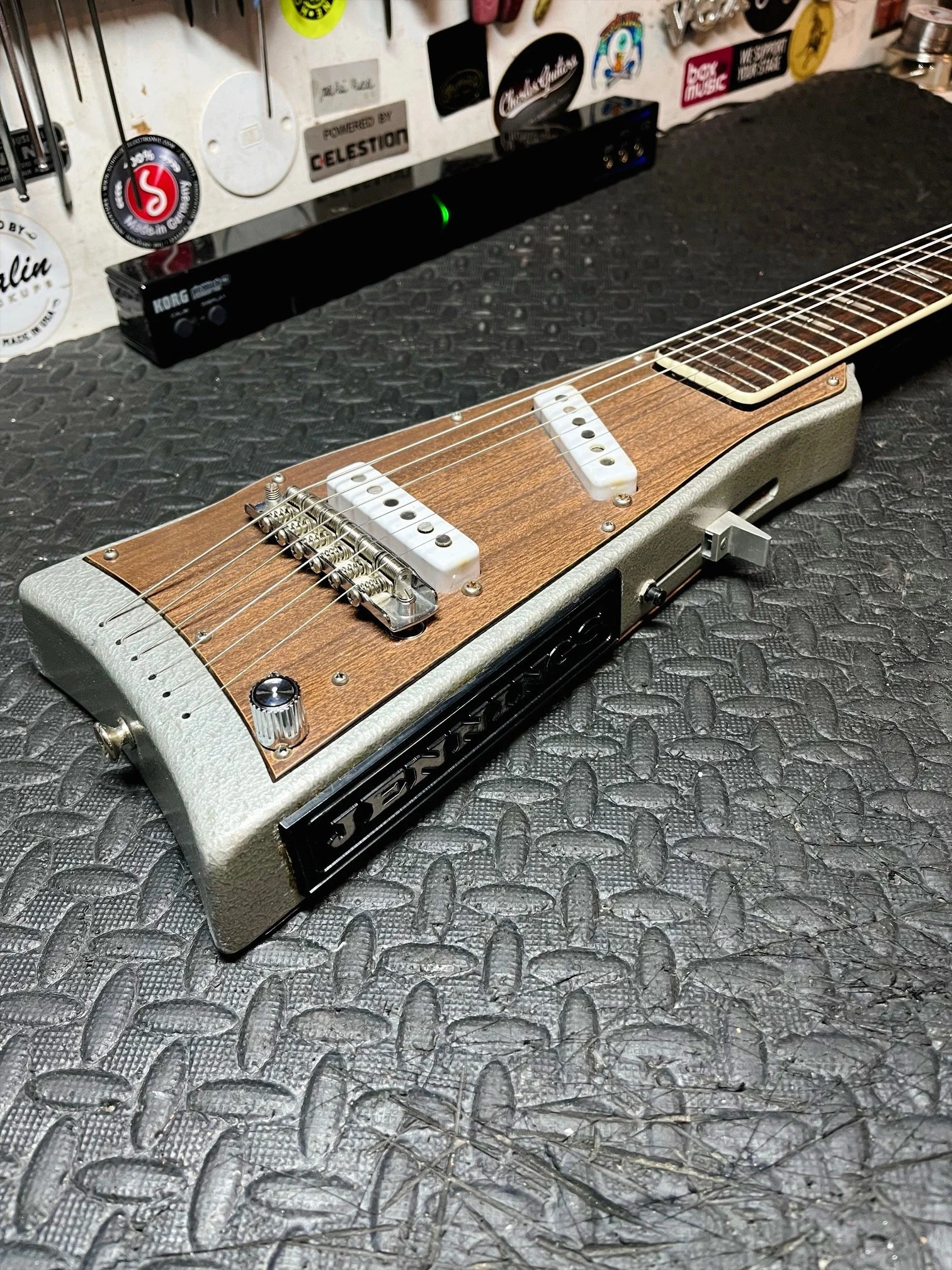
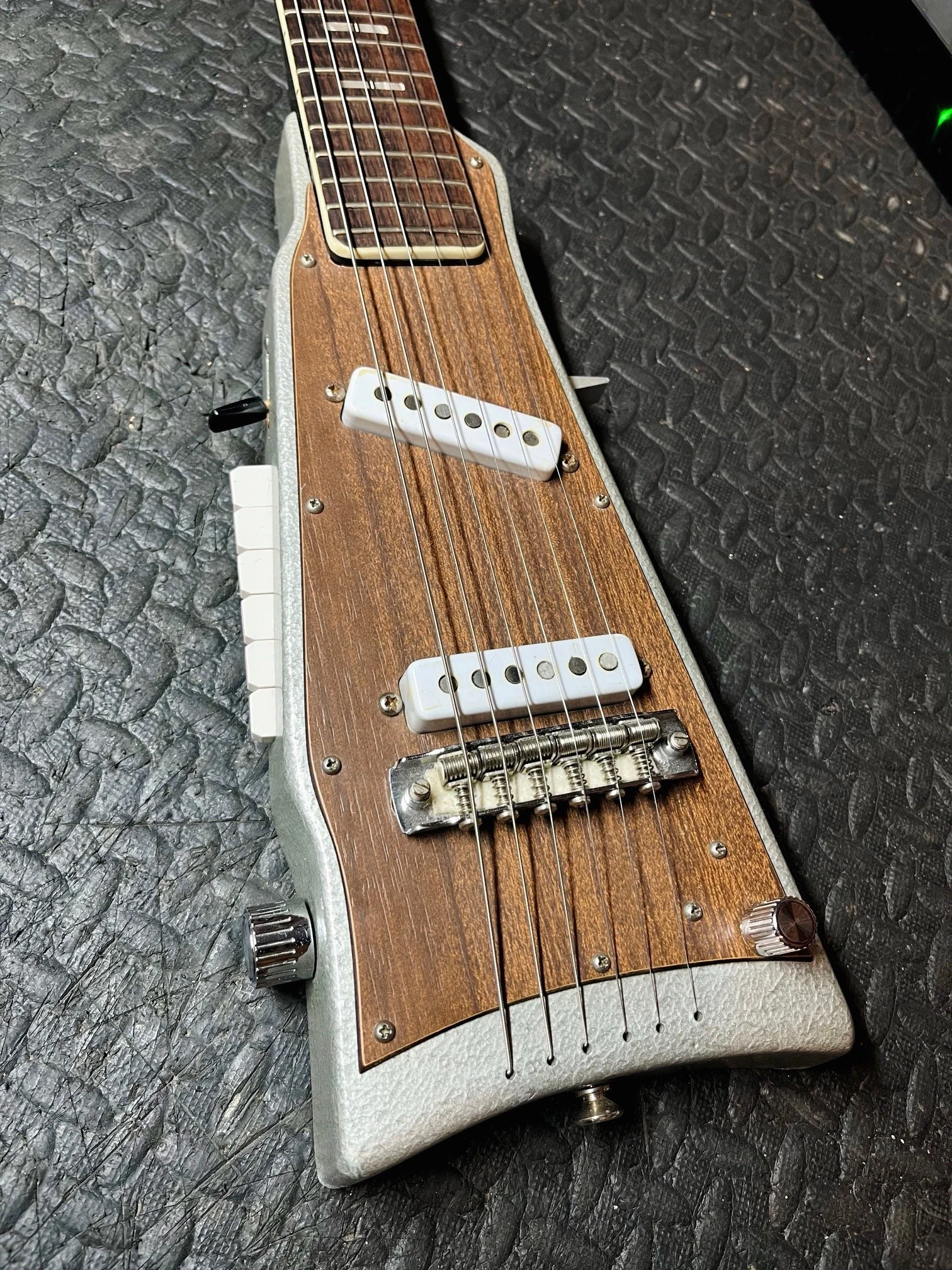
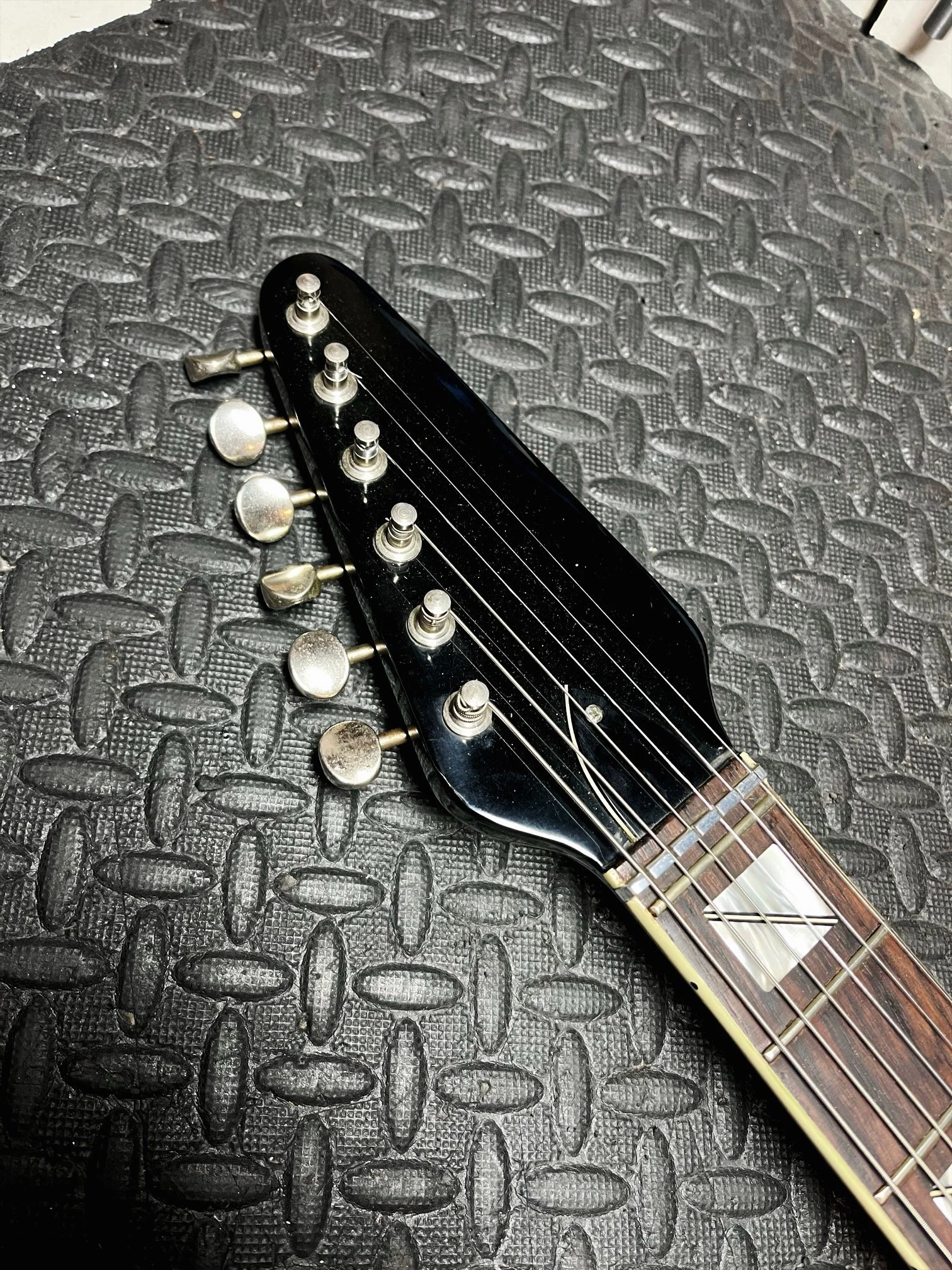
That’s where the Rifle instruments come in. The Winchester, along with the Outlaw and the Gunman bass, weren’t Vox instruments but they are very clearly the next step in that same line of thinking. The concept was pushed further: cast aluminium bodies shaped like rifle stocks, Italian-made necks in keeping with earlier Vox production, and a much stronger emphasis on built-in electronics and effects. The Winchester reflects that shift very well! It’s not just a guitar, it’s effectively a collection of early Jennings effects brought together into a single instrument.

To recap, there were three instruments offered in the range
THE OUTLAW. 6-string guitar. Volume, tone, and three switch pick-up sounds with rifle sound.
THE WINCHESTER. Introducing electronic tones, ie, "presence", treble, bass, fuzz, repeater, and changeover from electronic to guitar pick-ups, control of volume and repeat rate Three switch guitar pick-up sound.
THE GUNMAN BASS. This has volume, tone, three pick-up selection, fuzz, and rifle sound.
What’s Inside
Rather than a single signal path, the Winchester combines multiple existing Jennings designs internally:
Presence control
Bass booster
Treble Booster
Fuzz circuit
Repeater circuit
A effects on/of switch too, of course
These effects weren’t originally designed to live inside a guitar. They’ve been lifted from standalone units and integrated into one system, which makes for a fairly involved internal layout.
And then there’s the defining feature… the repeater.
The Repeater and the “Trigger”
The repeater circuit is where things get particularly interesting.
Looking at the schematic, what you’ve effectively got is a transistor-based switching stage that periodically interrupts the signal path. The timing of that interruption is controlled by an RC network, which sets the rate of the oscillation. In other words, how fast the signal is being gated on and off.
That’s the core of the effect, but the Winchester adds a physical interaction to it.
The rifle “trigger” acts as a bypass for the repeater stage, but in use it behaves more like a momentary control over that gating effect. When engaged, it produces a rapid, pulsed output (the “machine gun” sound) with the speed directly tied to the repeater’s rate setting.
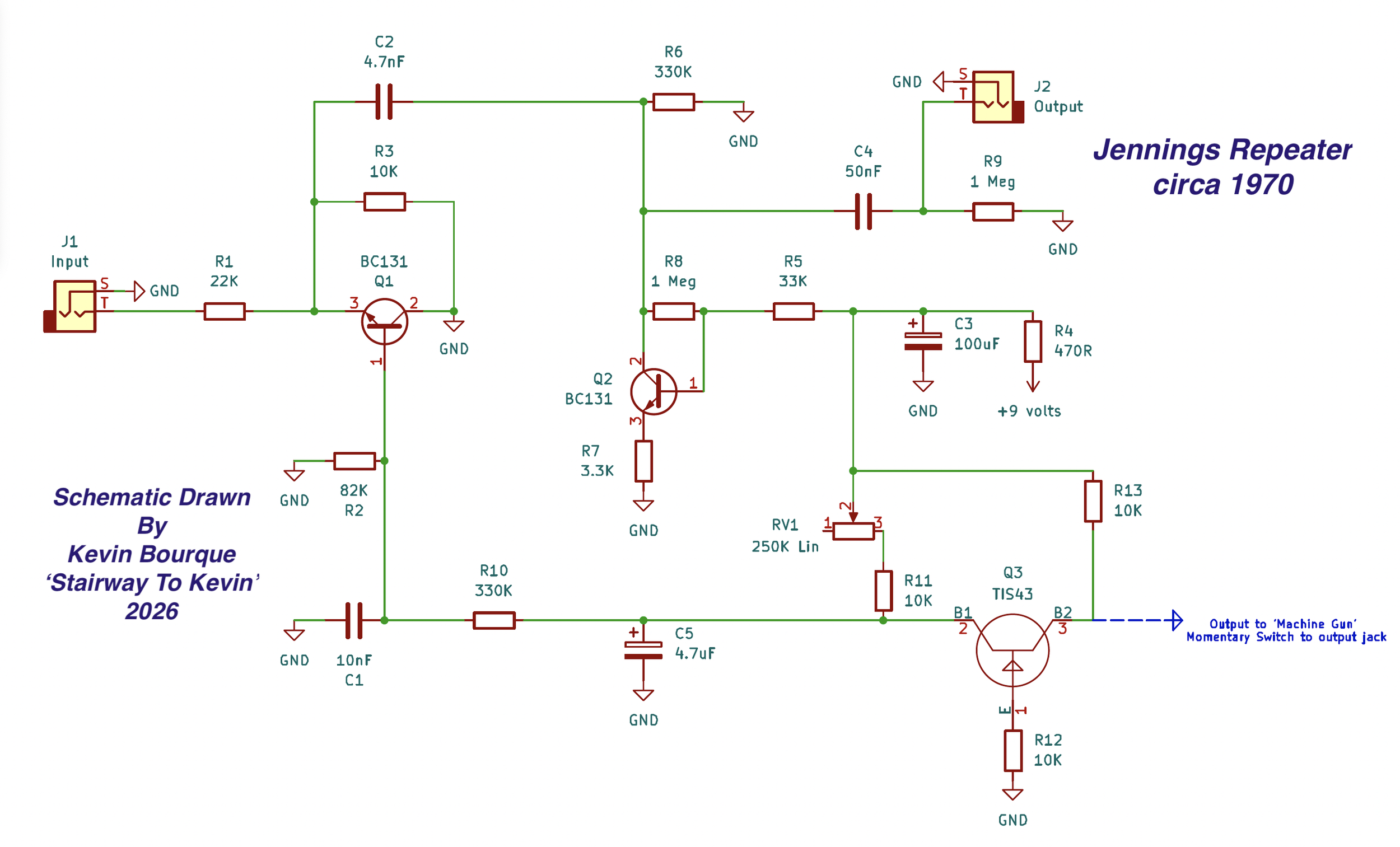
Jennings Repeater Schematic - click for better resolution
So electrically, you’ve got:
A signal path is being periodically switched by a transistor stage
A timing network defines how fast that switching occurs
And a physical control that brings that effect in and out in a very immediate, percussive way
It’s a clever idea, and it works, but it adds another layer of dependency to an already complex system.
The Condition It Arrived In
As is often the case with something this old and this unusual, it hadn’t made it to the present day untouched.
It had clearly been worked on before (multiple times, oh no!) and not particularly carefully. Internally, it was a complete mess.
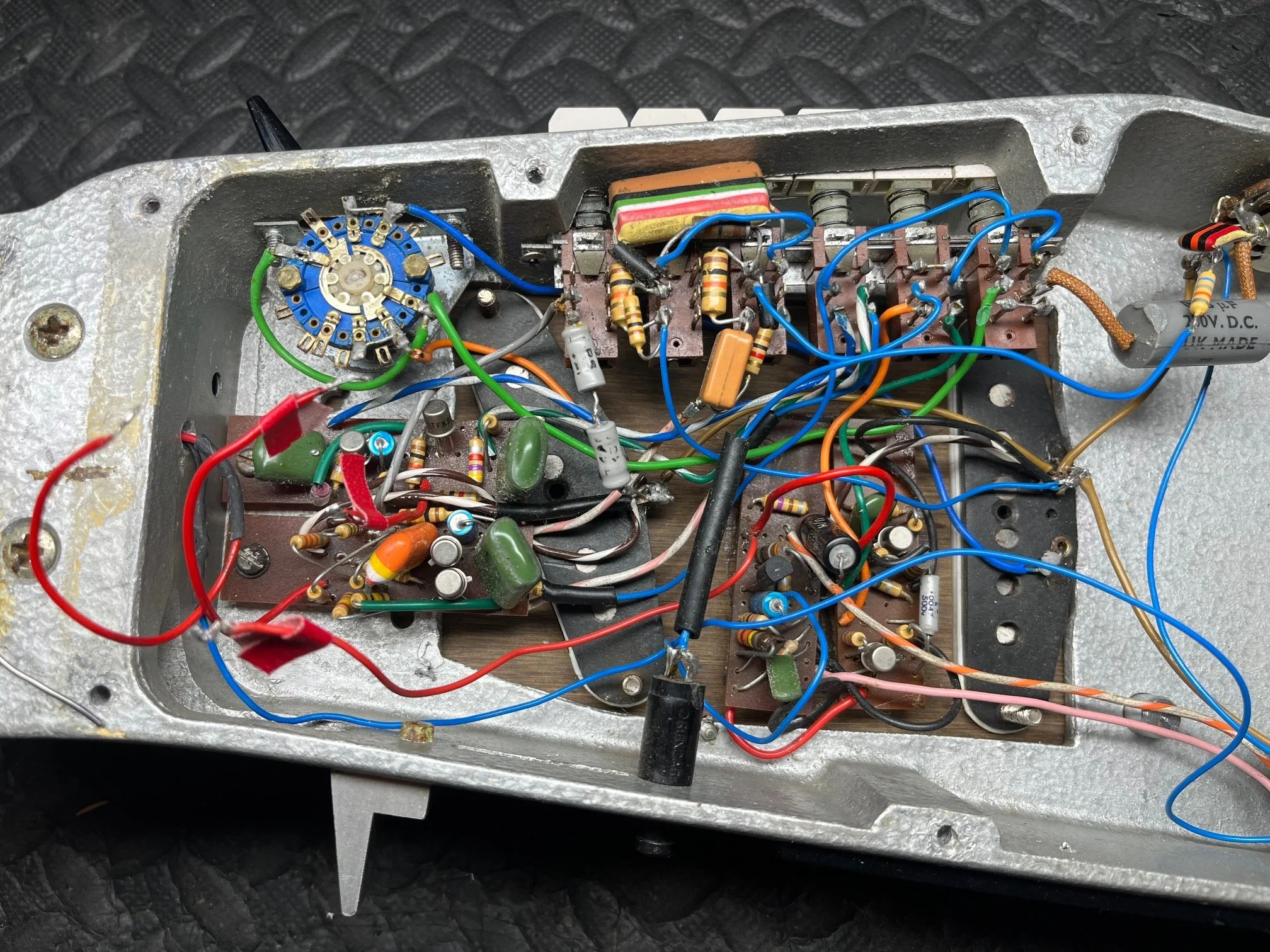
There were components that had failed outright, others that had drifted well out of tolerance, and a number that had been replaced with little regard for what they were actually doing in the circuit. Wiring had been altered, sections didn’t quite match what you’d expect from the original design, and there was not a lot of point where you could say with confidence, “this is just how it left the factory.”
That immediately changes the nature of the job because I’m not starting from a known baseline, I’m trying to reconstruct one.
Why This Isn’t a Simple Repair
From the outside, it’s easy to assume that faults should be isolated and fixable in a clean, linear way.
That doesn’t apply here because the Winchester is effectively multiple circuits interacting with each other, and problems don’t stay contained.
A drifting component in the booster can affect how the fuzz responds
An issue in the repeater stage can influence the overall signal continuity
Changes made during previous repairs can introduce entirely new behaviours
And once you start correcting one area, you often expose issues in another, plus that’s before you even factor in the age of the components themselves.
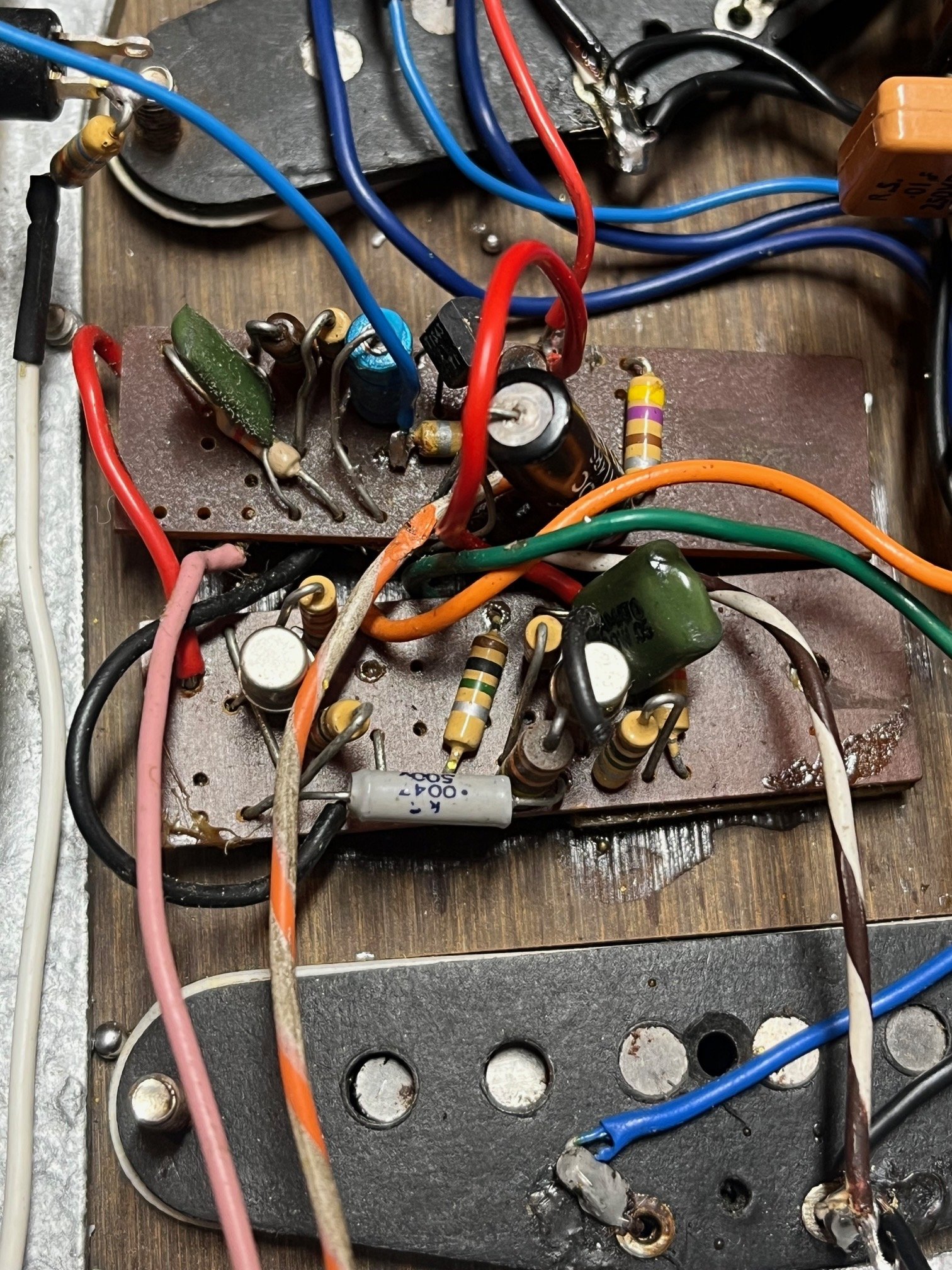
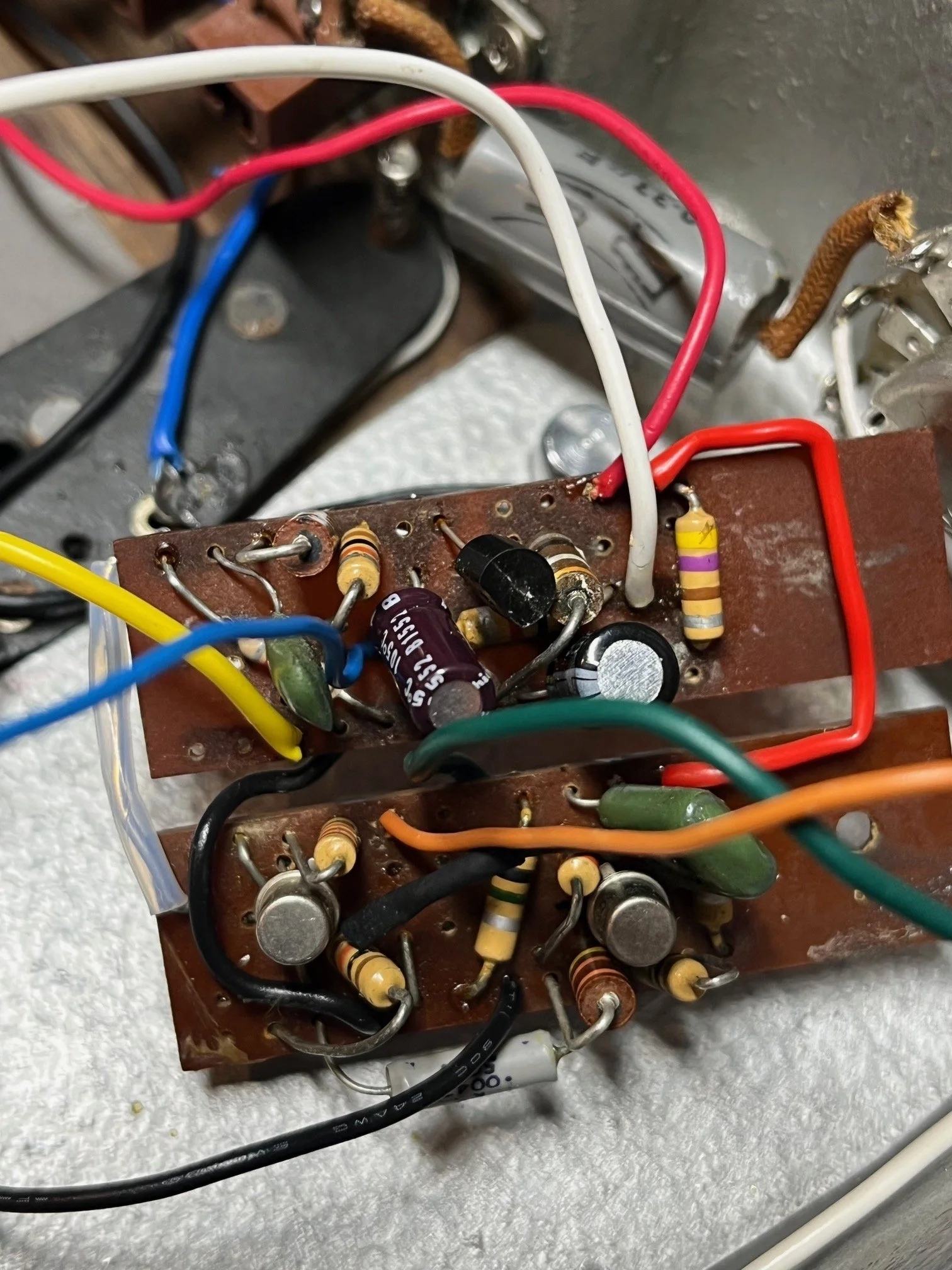
At 50+ years old, many components in there are either already compromised or heading that way. Capacitors drift, resistors move out of tolerance, and none of that happens in isolation. Gratefully, the transistors did seem to behave close enough as they originally would have. A few of the mechanical components needed replacing, some resistors, as well as every electrolytic capacitor. Some of the mechanical pieces, like the switches, needed a cleaning and tightening, but wonderfully they could be reused, since the likelihood of finding suitable replacements that fit nowadays is slim.
No Reliable Map
Even with a schematic, you’re not working with certainty in dealing with vintage electronics; between production variation, modifications over time, and the general lack of documentation for something this niche, the schematic becomes more of a guide than a definitive reference. In this instance, there weren’t any schematics to find anyway. As seen above, I drew my own based on this example
So the process becomes:
Trace the actual signal path as it exists
Compare that to what should be there
Identify what’s original, what’s been changed, and what’s simply no longer working
And then decide how far you go in bringing it back
In this case, the owner wanted it all working correctly again, with as few modifications to the guitar as possible; preferably none if that were an option. That’s not a quick fix, it’s a careful, methodical reconstruction.
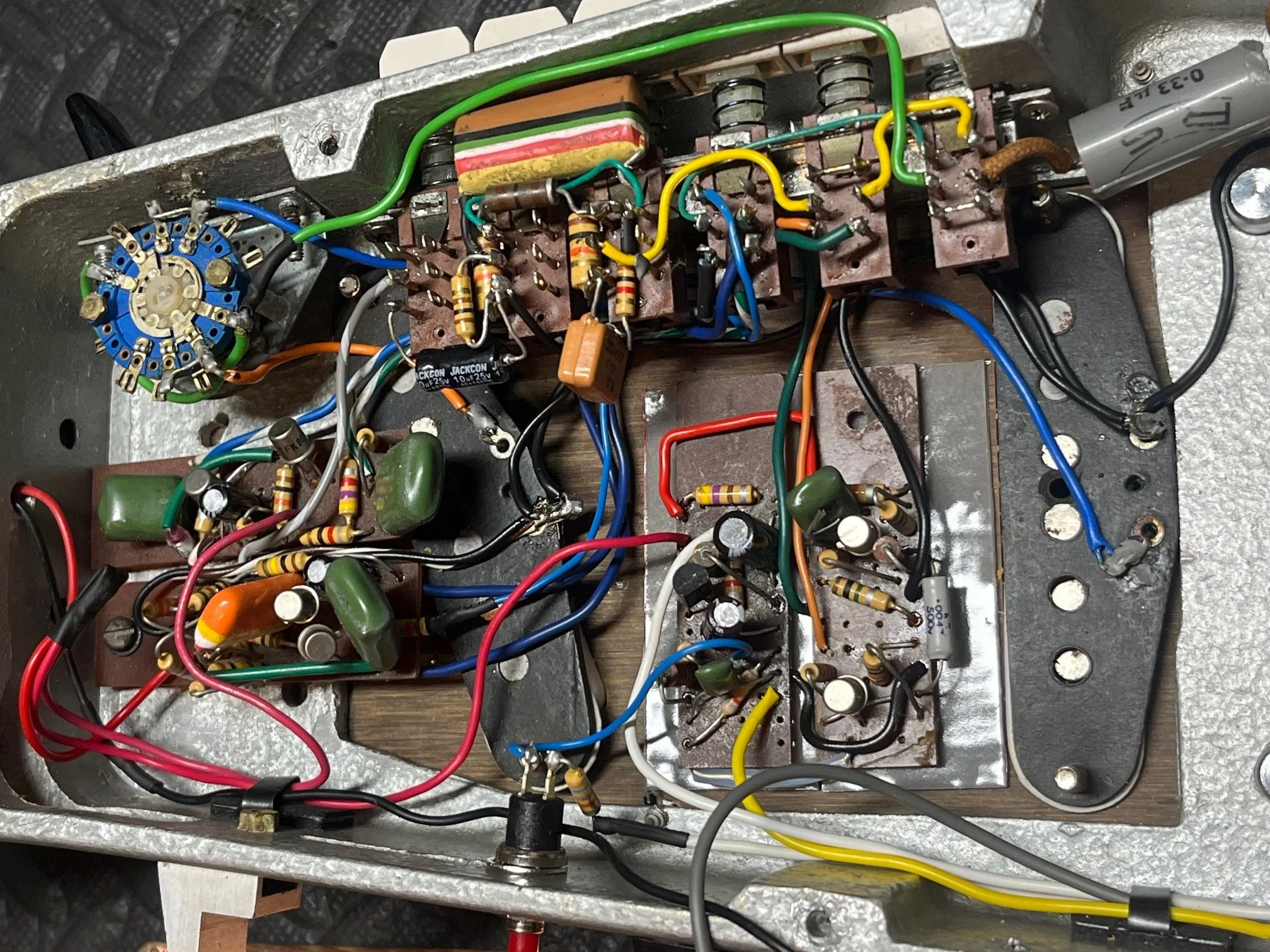
So this is where things get even more complicated because the job isn’t just about getting it working again.
It’s about making decisions:
What do you restore to the original spec?
What do you stabilise for reliability?
What do you leave alone because changing it introduces more risk?
Every choice will have consequences, especially in a circuit where everything is so closely linked.
Noise, Crosstalk, and Reworking the Layout
One of the biggest practical issues inside the guitar wasn’t just component failure, it was noise.
There was a significant amount of unwanted signal present throughout the circuit. Crosstalk between the different effect stages meant that even when certain effects weren’t engaged, you could still hear elements of them bleeding through into the signal path.
The fuzz was bad, but the repeater was the worst offender. Even when bypassed, there was a constant ticking present in the background — the oscillator still doing its job, but now leaking into places it shouldn’t be. In an instrument like this, where everything is tightly packed and sharing space, that kind of interference builds quickly.
To get on top of it, the internal layout had to be reconsidered. Shielded cable was introduced in key parts of the signal path to reduce interference, and some of the effect sections were physically repositioned within the guitar to minimise interaction between them. That alone made a noticeable difference, but it wasn’t enough to fully deal with the repeater bleed.
So a filter network was designed and added into the circuit, a carefully chosen resistor and capacitor combination to suppress that ticking without killing the character of the effect itself.
That balance is important: Too aggressive, and you lose what makes the repeater interesting. Too light, and the noise remains.
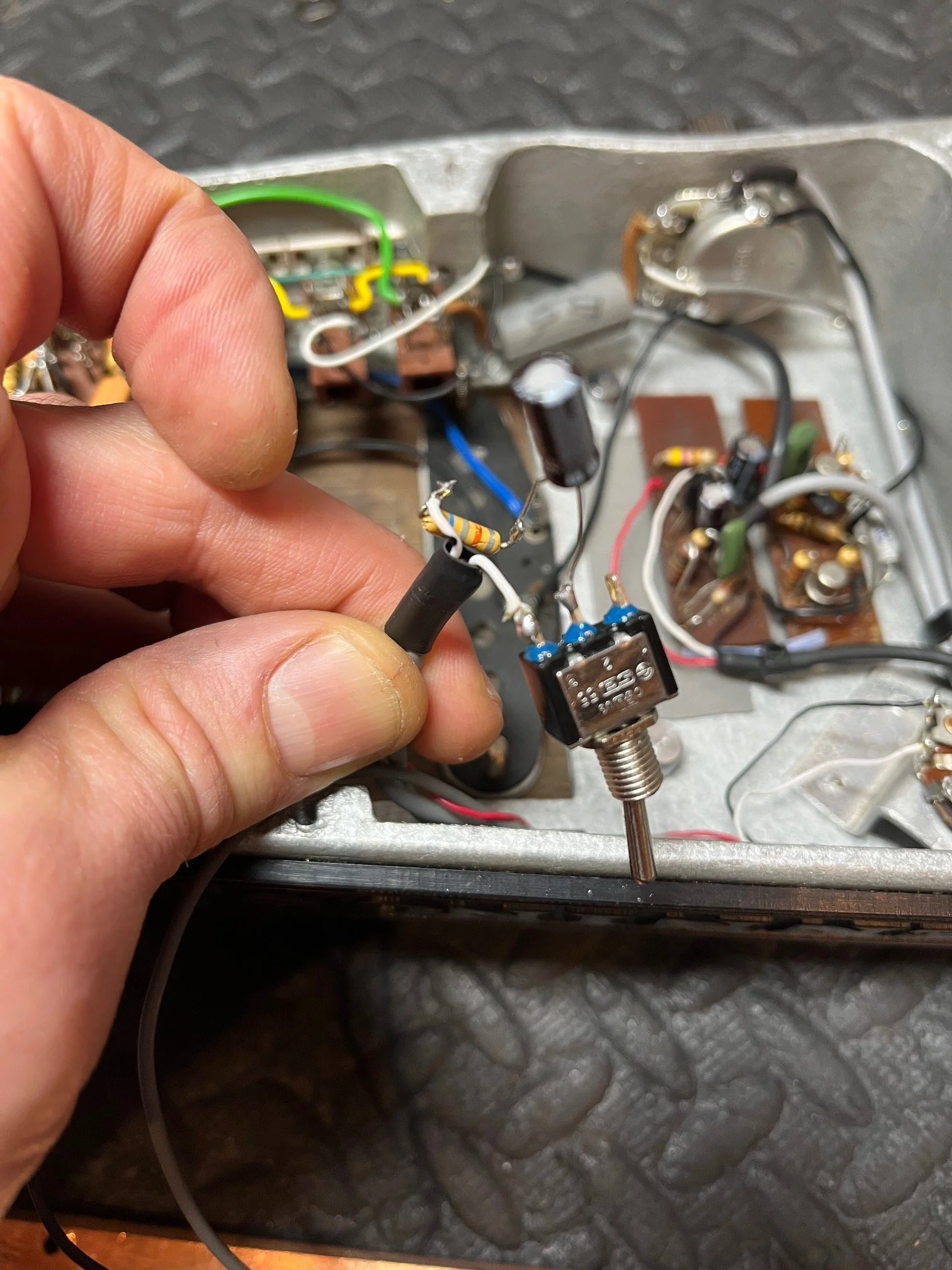
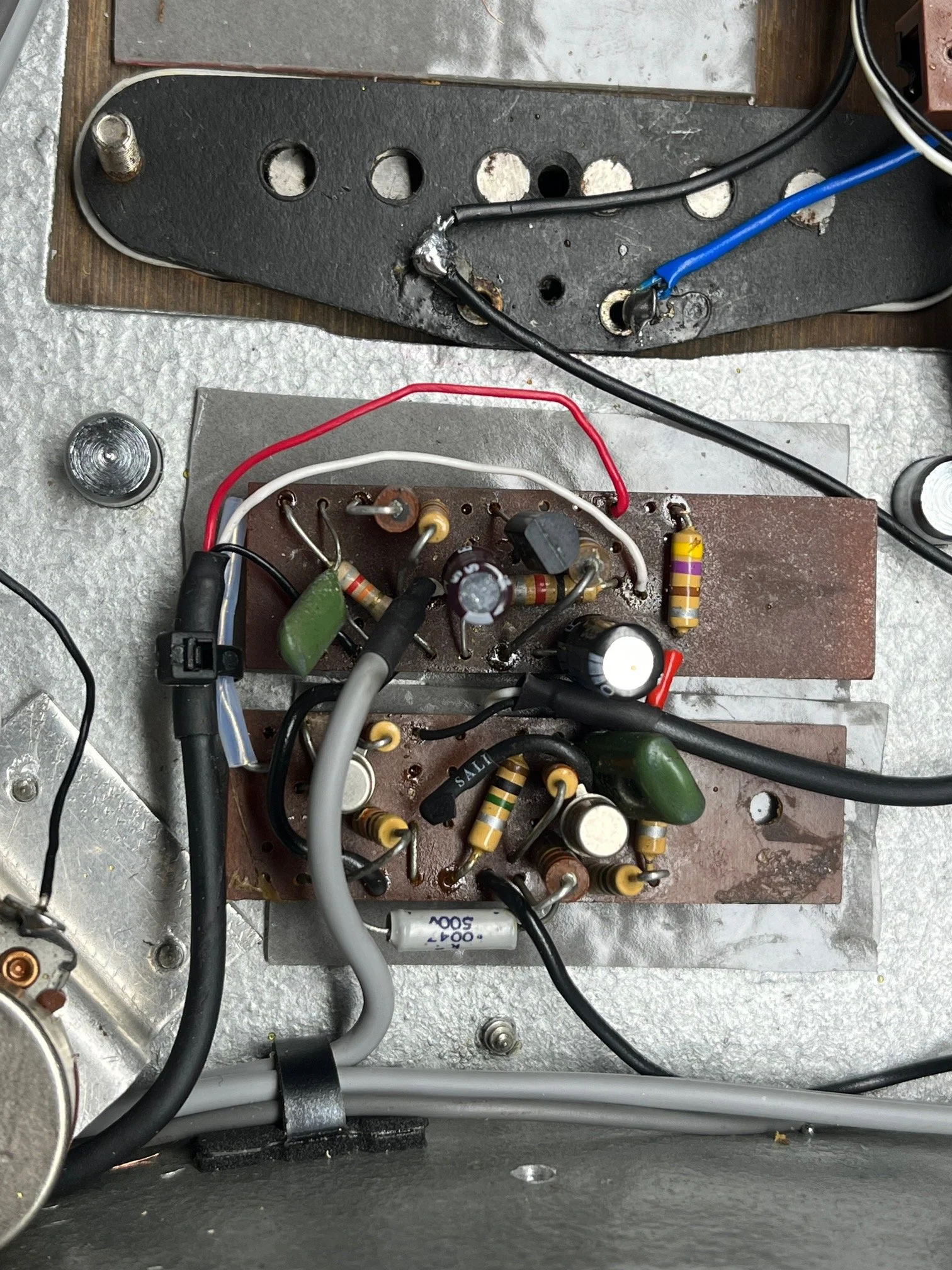
Once dialled in properly, the result was a significant reduction in background ticking, while still allowing the effect to function as intended, and especially when paired with a new, heavy-duty ‘trigger’ switch that gave the repeater a much more solid and usable feel in practice.
At long last, it kicks
The Jennings Winchester is a rare piece of design — not just visually, but electronically. It represents a moment where experimentation took priority over long-term serviceability, and where multiple ideas were brought together into something genuinely unique. The repeater works wonderfully now, along with all the other effects, and the fuzz sounds amazing too!
It also highlights something that comes up time and time again on the bench:
Once an instrument has been altered, repaired, and aged over decades, you’re no longer dealing with a clean system. You’re dealing with layers of history, interacting in ways that aren’t always obvious, and at that point, there’s no such thing as a simple repair.
After a crazy amount of hours working on this, I’m glad that I could finally return a fully working example to the owner and his dad, and I’m guessing many more years of enjoyment will come from it now!